
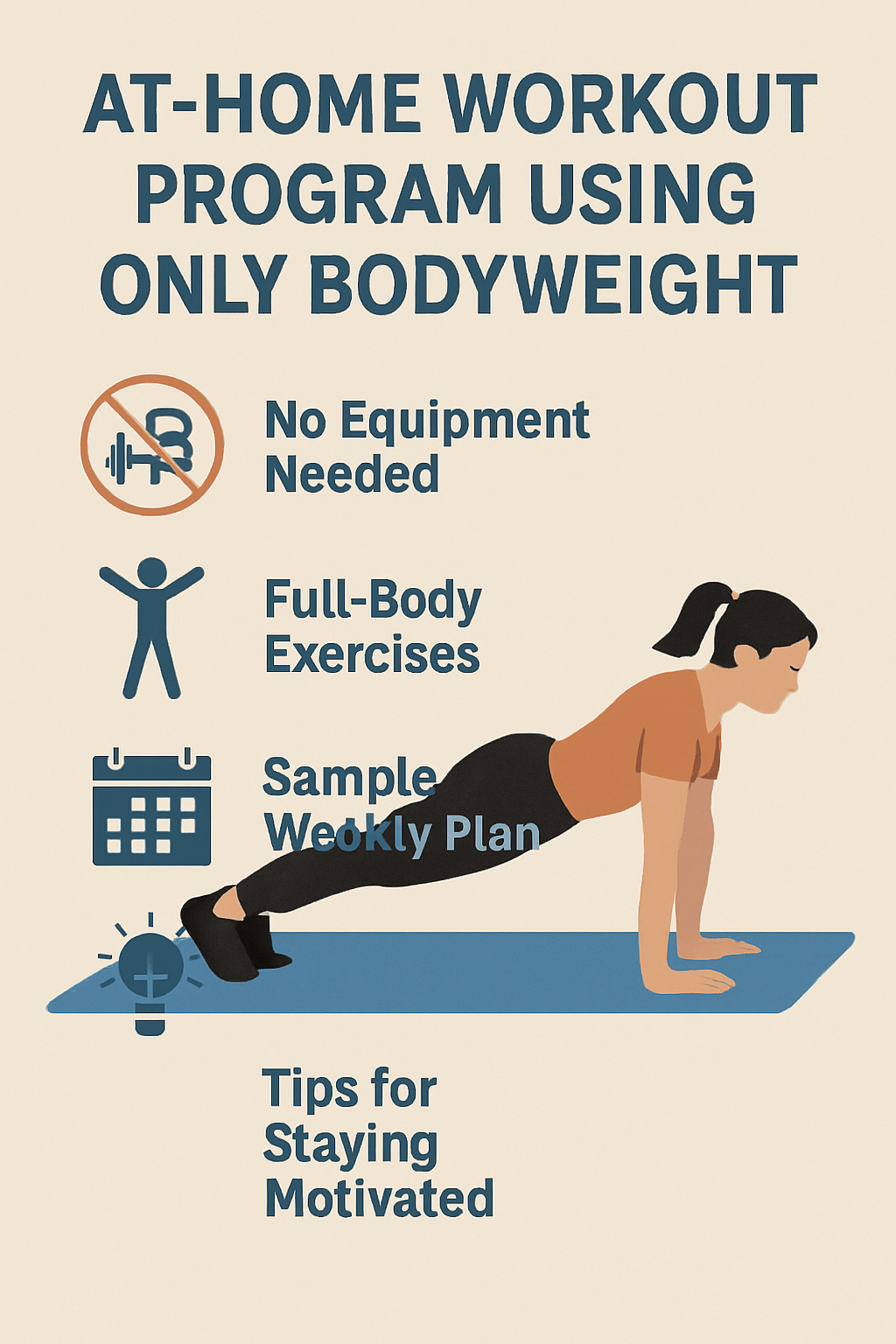
Why Choose an At-Home Bodyweight Workout Program?
In today’s busy world, hitting the gym isn’t always convenient—or even possible. Whether you’re juggling work, family, or simply prefer working out in your own space, an at-home workout program using only bodyweight can be a game changer. You don’t need fancy equipment or a gym membership, just your own body and a bit of motivation!
Bodyweight exercise can build strength, improve flexibility, and boost endurance using just your own body as resistance. Plus, they can be easily modified for any fitness level, making them perfect for either beginners or seasoned athletes. Bodyweight exercises can also reduce risk of injury because there are no heavy weights putting overdue stress on your joints as well as no resistance bands that can snap back and hit you in unpleasant areas. You know what I mean.
So let’s take a look at some benefits of a bodyweight routine and how you can get started with your own routine today.
Benefits of Bodyweight Exercise at Home
- No Equipment Needed: No dumbbells, no resistance bands, no machines—just your body.
- Cost-Effective: Zero cost, zero hassle.
- Flexible Timing: Exercise anytime without waiting for machines or classes.
- Full-Body Engagement: Work multiple muscle groups at once. Not to mention that you can also vary your speed to keep your heart rate up for a bit of a cardio workout.
- Improved Mobility & Balance: Bodyweight moves often include functional movements that enhance your daily life. Let’s face the fact that there are not many times in your daily life that you need to repeatedly press heavy objects over your head 6-8 times in a row. Bodyweight exercises can let you focus on movements that are a bit more natural.
How to Set Up Your At-Home Bodyweight Exercise Space
You don’t need a ton of space; a small corner with a yoga mat or towel will do. Make sure you have:
- Enough room to stretch out horizontally and vertically
- A comfortable, non-slip surface
- Water bottle nearby
- Timer or stopwatch (your phone works fine)
Just be aware of your surroundings so you don’t bump into a wall or knock a lamp off a table. You don’t need a huge area as long as you have enough room for your body to move around comfortably.
Key Components of an Effective Bodyweight Exercise Program
To create a balanced workout, focus on these components:
- Warm-Up: Get your blood flowing and muscles ready. This can be done with something as simple as doing some stretches to get loosened up.
- Strength Training: Target major muscle groups, areas like your chest, back and thighs.
- Cardio Blast: Increase your heart rate. Increasing the tempo of your exercise can help give your heart a good workout as well as moving quickly from one exercise to another.
- Core Work: Strengthen abdominal and lower back muscles. These muscles are very important for your daily life, having a strong core and good posture is always a good thing to have.
- Cool Down & Stretching: Prevent soreness and improve flexibility. Stretching after your workout is just as important as doing it before the workout, the last thing you want is to have sore muscles the next day convincing you to skip your next workout.
Sample Weekly At-Home Bodyweight Exercise Plan
| Day | Focus | Exercises | Duration |
| Monday | Full Body Strength | Push-ups, Squats, Lunges, Planks | 30-40 min |
| Tuesday | Cardio & Core | Jumping Jacks, Mountain Climbers, Sit-ups | 20-30 min |
| Wednesday | Active Rest | Light yoga or stretching | 15-20 min |
| Thursday | Lower Body | Glute Bridges, Wall Sits, Step-Ups | 30 min |
| Friday | Upper Body & Core | Tricep Dips (on chair), Plank Shoulder Taps | 30 min |
| Saturday | Cardio HIIT | Burpees, High Knees, Jump Squats | 20-25 min |
| Sunday | Rest | Complete rest or gentle stretching | – |
This is just a small example of the variety of exercises you can do, with bodyweight only, to help achieve your fitness goals. You can do these exercises (and others) in sets of 10-15 reps and do 3-5 sets for each.
Breakdown of Essential Bodyweight Exercises

Push-Ups: The Ultimate Upper Body Builder
Push-ups are a great bodyweight exercise, they work your chest, shoulders, triceps, and core. Start in a plank position, hands shoulder-width apart. Lower your body until your chest nearly touches the floor, then push back up until you have fully extended your arms. For a less strenuous version you can modify by lowering your knees to the floor.

Squats: Don’t Forget Leg Day
Stand with your feet hip-width apart. Bend your knees and push your hips back as if sitting in a chair. Keep your chest up and your back straight and allow your knees reach over your toes. Rise back to standing and squeeze those glutes to help push you up. When done properly squats can strengthen your quads, hamstrings, and glutes.

Planks: Core and More
Hold your body in a straight line from head to heels, supported on forearms and toes. You can also do a variation of this where you are supported on your hands instead of elbows, just like the beginning position of a push-up. Engage your core and hold for 20-60 seconds, make sure to keep your back straight throughout the exercise. Planks are great for core stability and endurance.

Lunges: Balance and Strength
Step forward with one foot and lower your hips until both knees are bent at about 90 degrees. Your arms can be hanging to the side or hold them out a bit to help maintain balance. Push back to standing and repeat on the other leg. Lunges target legs and improve balance, however this can be a bit stressful on your knee joints so be careful not to dip down too far.
Burpees: Cardio and Strength Combo
If you really want to punish yourself…I mean push yourself then the Burpee is right for you. This exercise will combine several different exercises into one heart-pumping, sweat-dripping exercise. Start out standing like your are going to do a squat an then drop into a squat until your hands are on the floor. Kick your feet back to a plank position and then do a push-up. Next you will spring your feet forward back to the squat position with your hands still on the floor and then explode upward with a jump. Great, that’s one rep, once you completed the jump then immediately start all over do all of those movements again. It’s a full-body cardio powerhouse, you can adjust the intensity by changing your tempo.

Interested in getting started?
Transform your health and Improve your Performance.
Boost your Testosterone to get your fitness a kickstart.
Tips for Staying Motivated in Your At-Home Workout Journey
- Set clear, achievable goals. Even small wins are still a win.
- Track your progress with a journal or app. There are plenty of free apps available.
- Mix up exercises to avoid boredom. Repetition can get boring so change things up once in a while to surprise your muscles.
- Find a workout buddy or join an online community. This can provide some accountability and encouragement to keep you on track.
Here’s another great way to do some At-Home Fitness >> Click Here
Frequently Asked Questions About At-Home Bodyweight Workouts
Q1: Can I really get fit using only bodyweight exercises?
Absolutely! Many athletes and trainers emphasize bodyweight training for strength and conditioning. It’s effective for building muscle, burning fat, and improving endurance.
Q2: How often should I do bodyweight workouts?
Aim for at least 3-5 sessions per week, varying intensity and muscle groups to avoid overtraining.
Q3: What if I find some exercises too hard?
Modify! For example, do push-ups on your knees or reduce plank hold time. Progress gradually.
Q4: Do I need to warm up before bodyweight exercises?
Yes, warming up reduces injury risk and improves performance. Simple movements like arm circles, leg swings, and marching in place work well.
Q5: Can bodyweight workouts help with weight loss?
Yes, combining strength moves with cardio and a healthy diet can support weight loss.
Q6: What if I want to build muscle mass?
Bodyweight exercises can build muscle, but progressively increasing difficulty or reps is key. You can also add tempo changes or plyometric moves.
Final Thoughts: Embrace Your Bodyweight Workout Journey
An at-home workout program using only bodyweight is flexible, effective, and accessible. With consistency and proper form, you’ll see improvements in strength, stamina, and overall well-being. No gym membership required—just you, your space, and the power of your own body!
For more workout inspiration and tips, check out Nerd Fitness’s Beginner Bodyweight Workout.